Friday, June 17, 2011

Week 5 - Venezuela 2 (Yanomami)

PARTS 1 and 2. The Yanomami Indians: Fierce People or Fierce Anthropology?

Associated Readings

  1. Peter Winn, selections from Chapter 7 of Americas (“Children of the Sun”), pp. 250-254 (2006)
  2. Robert Borofsky, Front matter and Chapters 1-3 of Yanomami: The Fierce Controversy and What We Can Learn from It, pp. 1-52 (2005)
  3. Robert Borofsky, Chapters 4-7 of Yanomami: The Fierce Controversy and What We Can Learn from It, pp. 53-106 (2005)
  4. Gustavo Lins Ribeiro and Paul Little, “Neoliberal Recipes, Environmental Cooks: The Transformation of Amazonian Agency,” from The Third Wave of Modernization in Latin America, pp. 175-192 (1998)
Introduction
If you’re an anthropology major, there’s a good chance you’ve already heard of the Yanomami (also called the Yanomamo; either name is aok).  With a population of more than 20,000, they are one of the largest indigenous societies in Latin America.  Since contact with the outside world was relatively recent (roughly, the 1960s), they have been of immense interest to anthropologists as an example of "pristine" tribal society.  (This notion of "pristine" is problematic, and we'll interrogate it later on.)  For this and other reasons we'll discuss later on, various aspects of Yanomami life in the Amazon rainforest have been heavily studied by anthropologists.  My discussion of the Yanomami is divided into three parts.  First, we’ll get to know them as an anthropological case study, focusing on their “traditional” cultural practices, including subsistence mode, residence pattern, political organization, and kinship structures.  Then, we’ll consider the implications of  various forms of contact the Yanomami have faced from the outside world roughly since the 1960s.  Finally, we’ll focus on a major controversy involving the Yanomami, a world-renowned geneticist, and one of the most well-known cultural anthropologists of the late 20th century.

I. The Yanomami:  Introduction to a Tribal Amazonian Culture


Where Do They Live?
The Yanomami live in some 300 villages spread out over the tropical Amazonian rainforest of southern Venezuela and northern Brazil.  You can see where they are concentrated on the following image:


Residence Patterns

The Yanomami live in villages usually consisting of their children and extended families. Village sizes vary, but usually contain between 50 and 400 people. In this largely communal system, the entire village lives under a common roof called the “shabono.”  Shabonos are oval shaped, with open grounds in the center about 100 yards long.  Here's what a shabono looks like:


Under the roof, individual houses and spaces are partitioned by vertical support posts. Shabonos are built from raw materials from the surrounding jungles, such as leaves, vines and tree trunks. They are susceptible to heavy damage from rains, winds, and insect infestation. As a result, villagers build new shabonos every couple of years.

Subsistence Pattern

For those of you new to anthropology, allow me to introduce the term "subsistence pattern."  In essence, this term refers to the way a given society makes use of resources in its environment to survive and otherwise "get by."  In anthropology, five broadly defined subsistence patterns are recognized.  These are:
  1. Hunting and gathering (also known as foraging) - when no crops or animals are grown, but instead a society depends entirely on what is naturally available "in the wild" (e.g., fruits, nuts, roots, and vegetable which can be gathered and meat and game which can be hunted); can support relatively small groups of people.
  2. Horticulture - small-scale gardening, no use of irrigation or fertilizer, so production is neither continuous nor intensive. Typically involves "slash and burn" techniques, that is, clearing a parcel of rainforest by burning its contents, using the parcel until the soil loses its nutritive capacity, and then abandoning it.  (Although this sounds "not green-friendly," it is actually a very sustainable form of subsistence as long as there is enough land for abandoned plots to have sufficient time (typically ten years) to regenerate.  Horticulture can support larger populations than foraging, but not as large as cities.
  3. Pastoralism.  Relying primarily on animal protein from herded animals (typically cattle, sheep or goats) for survival.
  4. Agriculture.  The defining characteristic of agriculture is its use of fertilizer and irrigation which allows it to be both intensive and continuous (year-round).  Most agricultural societies focus on one primary crop (for example, rice, wheat, or soy beans).  This is called "monocrop production."  Very labor-intensive but can support quite large populations, including state-level societies and cities.
  5. Industrialism.  Includes industrial agriculture and factory production.
While the Yanomami do some foraging, most of their nutritional input comes from horticulture, as defined above.  Their primary horticultural crops are plantains (similar to bananas) and cassava, although they gather naturally available fruits and berries from the rainforest and hunt animals and fish as well.  Typically, each village has its own garden.  The Yanomami frequently move to avoid areas that become overused, a practice known as shifting cultivation when the soil becomes exhausted.  The Yanomami celebrate a good harvest with a massive feast to which nearby villages are invited. In this way, food helps to maintain good relations with their neighbors.

Social Organization
Children stay close to their mothers when young; most of the childrearing is done by women. The Yanomami traditionally practice polygyny (men can have more than one wife), though many unions are monogamous. Polygamous families consisted of a large patrifocal family unit based on one man, and smaller matrifocal subfamilies: each woman's family unit, composed of the woman and her children. Life in the village is centered around the small, matrilocal family unit, whereas the larger patrilocal unit has more political importance beyond the village.

Political Organization
Each Yanomami village has a "village headman."  This isn't a hereditary position -- one isn't born into it.  Rather, a man who achieves prestige through his skills as a warrior, as an effective speaker, and as generous in his offerings to community feasts may become accepted as the headman.  More about the position of village head:
  1. It comes with very limited authority:  He cannot force or coerce people to do things.  Rather, he can only persuade, harangue, and try to influence people to do things.
  2. The village head acts as a mediator in disputes, but he has no authority to back his decision or impose punishments.
  3. The village head must lead in generosity: He must be more generous, which means he must cultivate more land.  He also hosts feasts for other villages.
One of the reasons the Yanomami have been of interest to anthropologists is their extremely high level of inter-village warfare and their high rate of homicide.  Indeed, based on estimates from anthropological accounts, fully 25% of adults die from warfare.  (Typically, the causes of warfare are a sexual affair or one village's failure to deliver a woman for marriage to a man from another village.)  These statistics led anthropologist Napoleon Chagnon to call the Yanomami "the fierce people"--and this label has stuck.


Now, you might ask yourself, why should we care about warfare among the Yanomami?  What's the big deal?  To come at an answer to this question, consider your own view of "human nature."  Do you believe people are "naturally" peaceful and it is only society that drives people to violence?  Or, do you think humans are innately selfish, aggressive, and inclined to violence, and it is only society that teaches us to be "civilized"?  As a rare instance of a society with minimal contact with western civilization until recently, the Yanomami--for better or worse--have been seen as providing a "purer" view of human nature.  In the West, they have been taken as a symbol of what life is like beyond the pale of “civilization.”  Their high level of violence and warfare has been used (including by Chagnon) as evidence of an inherently violent and aggressive human disposition.  Since Chagnon's earliest publications in the 1970s, this argument has been extremely controversial.  Meanwhile, Chagnon's ethnographic monographs have become bestsellers.

II. The Consequences of Contact:  Challenges to Yanomami Livelihood


Until the 1980s, contact with the Yanomami was rare.  The discovery of gold on Yanomami land midway through that decade changed everything.  Within just a couple of years, miners flocked to southern Venezuela and northern Brazil, setting up mining operations through the illegal occupation of indigenous land.  These operations require laborers, and so have attracted droves of poor people from other regions to come to Yanomami lands to work in the mines.


I have prepared a short (half-hour) film, "Contact: The Yanomamo Indians of Brazil,” which provides a good (if troubling) introduction to the changes the Yanomami have faced since the 1980s due to the incursion of miners.  (The film is viewable under the "Videos" tab on Bb.)  To catch the key moments from the film, I have also prepared a short set of "viewing questions" below.  Read them over and scribble (or type) notes and possible answers as you are watching the film.  These notes are crucial to grasping what's important in this story.


Viewing Questions
1) It is useful to map out the various social actors represented in this film.  Look for each of the following:
 

a. The Yanomami, including their shaman, women and children.
b. The Miners (garimpeiros)
c. The Nurse (who speaks in English)
d. Politicians, including the country executive
e. The representative of the National Indian Foundation (FUNAI)
f. The market vendors
g. Activists at the Alta Mira summit


2) What have the Yanomami adopted from outsiders and incorporated into their ways of obtaining food? What Western tools do the Yanomami now use to hunt, fish, and gather crops?

3) What have the effects of mining been on the Yanomami’s subsistence economy?

4) What are the effects on the environment in general? Are there new ways of obtaining food that have come about as a result of the miners' invasion? Have miners influence ways in which food transactions are conducted (bartering vs. begging, exchange)? Have the miners introduced new foods?

5) How do the miners see the Indians? How do they perceive themselves in relation to the Indians? Do they think they are influencing the Indians in positive or negative ways, or a combination of both? Explain.

6) How do the Yanomami perceive the miners? Does more than one viewpoint exist, as shown in the film? What are Yanomami views about taking things from outsiders? Are they unanimously in favor? If not, what kinds of individuals are opposed? Why?

7) How has mining affected Yanomami health? What new diseases have they brought? Why are these so devastating? To what do the Yanomami traditionally attribute disease? In what ways are their views of disease similar or different from Western understandings? How have outsiders and their diseases changed the ways that Yanomami understand disease? cure disease? How, according to Yanomami thinking, are illnesses cured and what role do Western medicines have?


Activism

Toward the end of the film, we see an impressive example of organized political struggle in the form of the five-day Altamira conference held in 1989.  Here we see a different side of indigenous experience.  Rather than passive victims of the greed of the miners, Indians are shown to be creative, media-savvy, and united in their resistance to outside incursions.  The conference was organized and led by the Kayapó Indians, a group with much more experience with outsiders than the Yanomami, and well-known for their unusually effective negotiations and resistance strategies.  (The Kayapó, for example, have negotiated a deal with The Body Shop to sell Brazil nut oil from their lands.)


Environmentalism
So far, our discussion of Yanomami experiences with outsiders has focused on miners.  More recently, tensions have arose around a different set of interests, which we can broadly refer to as "environmental."  (The key text here is the assigned reading by Peter Little and Gustavo Lins-Ribeiro.)  The aim of this short article is to disabuse us of a naive vision of environmentalism.  Environmentalism, they argue, is not a simple "concern for the environment" which can (and should) be applied anywhere in the world where there is a threat.  Instead, environmentalism is a discourse -- a way of expressing ideas -- that serves the interests of different segments of society.  The segments that make use of environmentalism discourses are:

•    the state
•    multilateral and bilateral financing agencies
•    national and int’l NGOs
•    local populations
•    market-oriented actors


Since each segment is looking after their own interests, their use of environmentalism discourses is inherently political and inevitably gives rise to tension and disagreement.


According to the authors, the ways each sector expresses its concern over "the environment" vary.  As it turns out, there are three variations on how such concerns are expressed -- three "discourses of environmentalism," if you will.  These are:

1)    Amazonia is the world’s largest rainforest, and must be saved
2)    Amazonia is home to traditional peoples, whose livelihood is threatened
3)    Amazonia has the highest biodiversity levels in the world; these must be preserved


These three discourses might sound reasonable to you.  But consider a situation in which Yanomami Indians are asked by international "green" organizations to cease their traditional practice of slash-and-burn horticulture on the grounds that it contributes to deforestation (discourse #1).  In your discussion board postings for this week, you'll have the opportunity to consider this set of issues in more depth.

III.  The Fierce Controversy 

Robert Borofsky's book, Yanomami: The Fierce Controversy and What We Can Learn From It and José Padilha's 2010 film "Secrets of the Tribe" tell the disturbing, complicated, and at times entertaining story of anthropology's engagement with the Yanomami since the 1960s.  The anthropologist who receives the lion's share of Borofsky's attention is Napoleon Chagnon, mentioned in Section I above.  Borofsky also gives due attention to genetics researcher James Neel, whose grants to study measles among Amazonian populations helped fund Chagnon's early investigations as well.  "Secrets of the Tribe" focuses almost exclusively on anthropologists and provides provocative and at times chilling accounts of other anthropologists' engagements with the Yanomami, including Jacques Lizot and Kenneth Good.  While Chagnon's research and conclusions had been questioned for some time, it wasn't until the 2000 publication of journalist Patrick Tierney's Darkness in El Dorado: How Scientists and Journalists Devastated the Amazon that the so-called "fierce controversy" came to occupy center stage in U.S. anthropology.  If you haven't already, read the Borofsky text and watch "Secrets of the Tribe" now.


Friday, June 10, 2011

Week 4 - Venezuela

PARTS 1 and 2. Hugo Chavez and the Bolivarian Revolution

Associated Readings
  1. Steve Ellner, “Venezuela: A ‘model’ democracy in crisis,” in Latin America: Its Problems and Its Promise, pp. 399-412 (2011)
  2. Cristobal Valencia Ramirez, “Venezuela in the eye of the hurricane: Landing an analysis of the Bolivarian revolution,” pp. 173-186 (2006)
  3.  -- “Venezuela’s Bolivarian revolution: Who are the Chavistas?” from Venezuela: Hugo Chavez and the Decline of an ‘Exceptional Democracy’, pp. 121-139 (2007)
  4. Naomi Schiller, “Framing the revolution: Circulation and meaning of ‘The Revolution Will Not Be Televised’” Mass Communication and Society 12, pp. 478-502 (2009)
  5. Steve Ellner, “Chavez pushes the limits: Radicalization and discontent in Venezuela,” NACLA Report on the Americas, pp. 9-12 (2010)
Handouts ("Course Documents on Bb")
  1. Handout 5 ("Populism")
I. Introduction to Venezuela (Draws from World Scholar/Latin America & the Caribbean, 2011)

Venezuela, which shares borders with Colombia, Brazil, and Guyana, lies along the Caribbean Sea. Between the Andes Mountains in the northwest and the Guiana Highlands in the southeast lie central plains as well as a coastal region, with the country's climate varying from tropical to temperate.

Most U.S. citizens don’t know much about Venezuela.  If they do, they may have heard about its current--and very controversial--president, Hugo Chavez, who we’ll discuss at length below.  Or, they might have heard on Simón Bolívar, a Venezuelan military and political leader who led multiple struggles in Latin America for independence from the Spanish Empire during the 19th century.  And then there are the beauty pageants...In international competitions such as the Miss Universe competition, Venezuela continues to produce winners. Finally, many of you might buy gas at Citgo, which is owned by a major Venezuelan oil producer.

Colonial Past and Recent Political History
The Spanish established the first permanent settlement in Venezuela in 1522, but until the 1700s the colony remained largely undeveloped. Venezuela then became an important world producer of cacao, and Caracas emerged as a center of commerce. After several military battles with Spain under the leadership of Simón Bolívar, Venezuela declared independence in 1821. In 1830 the fledgling nation withdrew from its association with Colombia, Panama, and Ecuador in the Republic of Gran Colombia to become fully autonomous.

Throughout the nineteenth century Venezuela experienced many political upheavals. A series of authoritarian governments in the twentieth century brought more stability, with petroleum exports fueling economic expansion. In 1958 a two-party democratic system was introduced, but an economic crisis in the 1980s brought renewed unrest. In 1998 Hugo Chávez, who had been jailed six years earlier for his part in an unsuccessful coup, was elected president. I’ll have much more to say about this below.

Ethnicity and Cultural Practices
As is typical in Latin America, Spanish, native/indigenous, and African heritages have all contributed to Venezuelan life and culture, including language, art, food, and music.  About half of today’s population is of mixed ethnic heritage, that is, mestizo or mulatto.  About 85% of the national population (about 27 million as of 2011) live in urban areas in the northern portion of the country and currently resides in large cities such as the capital Caracas, cities that are concentrated in Venezuela's northern coastal mountain strip.  Both life expectancy (73.9 years) and literacy rates (95.1%) are high.  The vast majority (96%) of Venezuelans identify as Catholics, although many practice other forms of Christianity (for example, Evangelicals).

According to the World Refugee Survey 2008, published by the U.S. Committee for Refugees and Immigrants, Venezuela hosted a population of refugee and asylum seekers from Colombia numbering 252,200 in 2007. 10,600 new asylum seekers entered Venezuela in 2007. Between 500,000 and one million illegal immigrants are estimated to be living in the Venezuela.

II. Understanding Chavez and Chavismo 

In your readings from Week 1, you've already had an introduction to Venezuela's current president, Hugo Chavez.  As you may remember, Chavez became president after many years as a career military officer.  During the 1980s, he increasingly opposed the government (and the Venezuelan political system more generally) which he found corrupt and undemocratic.  In 1992 he led an unsuccessful coup attempt, out of opposition to massive social spending cuts which had recently been made by the government in its structural adjustment initiatives.  After two years, Chavez was released from prison and by 1998 had achieved popularity sufficient to get him elected president.  An opposition movement attempted to remove him from power both through an unsuccessful military coup in 2002 and a recall referendum in 2003.  The 2002 coup is the subject of the film you will watch during Week 4 (“The Revolution Will Not Be Televised”).  Chavez has been accused of manipulating the electoral process and instituting constitutional changes, including the end of presidential term limits, to retain power.

As president, Chavez has undertaken a massive social project known as the Bolivarian Revolution, named after Venezuela’s most famous historical figure, Simón Bolívar.  Following an ideology he and his followers call “Bolivarianism” and “Socialism for the 21st century,” his Bolivarian Revolution has entailed the implementation of a new constitution, the formation of new forms of participatory democracy (more on this below), and the nationalization of several key industries (most notably, the oil industry).  Chavez loyalists are known as Chavistas.  (The second reading by Cristobal Valencia Ramirez focuses on what sorts of people identify as Chavistas.)  If you have any friends from Venezuela, you will find out very quickly if they are Chavistas or not, as most Venezuelans have very strong feelings about this man!

A vocal critic of capitalism and in particular neoliberalism, Chávez has been a prominent opponent of the United States' foreign policy, which he describes as imperialistic.  Allying himself strongly with the socialist governments of Fidel and then Raúl Castro in Cuba, Evo Morales in Bolivia, and Rafael Correa in Ecuador, his presidency is seen as a part of the leftist "pink tide" sweeping Latin America.

Advocating forms of direct, participatory democracy (rather than representative democracy), Chavez has introduced a variety of initiatives which get ordinary citizens involved in decision-making around local resources.  These initiatives include the Bolivarian Missions, the Communal Councils, and worker-managed cooperatives.  Funded from oil revenue, the Bolivarian missions aimed at expanding public services through the construction of free medical clinics, implementing educational programs to increase literacy, and administering food and housing subsidies to poor people.

I have prepared an hour-long video for you to watch called “Journey with the Revolution” (“Videos” tab on BB).  As you will see, this film portrays the Bolivarian Revolution in glowing terms, showing multiple sectors of society who have become inspired by Chavez and for the first time in their lives have engaged in civic participation.  This film lasts about an hour.  Now is a good time to watch it.


III.  U.S. Perception of Chavez

To say relations between the U.S. government and Hugo Chavez are strained is an understatement.  In the eyes of  mainstream politicians in the U.S., both democrat and republican, Chavez has been (and remains) perceived of as an irritating troublemaker at best and a dangerous, undemocratic populist with ties to terrorist regimes elsewhere in the world. (See more on populism below.)


Watch Chavez's 2006 speech at the United Nations:


Now, a clip from his weekly TV broadcast, also from 2006, in which Chavez taunts President George W. Bush further:


Finally, here's Barbara Walters interviewing Chavez on ABC in 2007:


Chavez met U.S. President Barack Obama for the first time at the Summit of the Americas in 2009, where Chávez expressed a desire for better relations between the two countries. However, the Venezuelan president regularly engages in anti-American rhetoric, and relations continue to be strained.

Please watch "The Revolution Will Not Be Televised" at this point, if you haven't already. 

IV. Understanding the Appeal of Chavez 
How do we account for the massive popularity of Hugo Chavez among Venezuela’s poor?  Certainly, poor people have welcomed Chavez’s use of oil revenues to fund social services such as health clinics and schools.  But these material benefits alone are not sufficient to capture the distinctive appeal of this man’s style of leadership.  To help better understand this, we’ll use a concept from political science (the IR majors among you are probably already familiar with it)--populism.  While populist leaders aren’t limited to Latin America, some of the most well-known and heavily-studied populists have been from this part of the world.  (The discussion below corresponds closely to the “populism” handout available under “Course Documents” in Bb.)

Let’s define populism as a style of leadership “characteristically involving a proclaimed rapport with ‘the people’, a ‘them-and-us’ mentality, and (often, though not necessarily) a period of crisis and mobilization” (Alan Knight, 1998).

Populist leadership is typically based on personal charisma and skills as an orator--leaders who know how to give a stirring and inspiring speech.  Think of Chavez’s “You are a donkey, Mr. Danger!” performance from his weekly radio program (clip above).

Populist leaders seek a direct bond with their mass following. They lead personal movements rather than well-organized parties.  Again, Chavez is a good examples:  If you take him out of the "Bolivarian revolution," there would be nothing left.

Populism relies on mass mobilization--getting their followers out into the streets.

Populist leaders often have military backgrounds.  Part of their appeal is that of the military caudillo, or strongman, who promises to deliver justice for the "people" by firm measures against the "exploiters"

When used to describe a leader, the term “populist” almost always has negative connotations.  (Typically, it’s used to describe a politician who seeks popularity through appealing to the baser instincts of voters.)  Historically, it is in Latin America where populism has had the greatest and most enduring influence. Its heyday was from the 1920s to the 1960s, as industrialization and the growth of cities got under way in the region.  Against this backdrop, populism was the means by which the urban masses--the middle and working classes--were brought into the political system.


As you get a grasp on the concept of populism, resist the temptation to decide whether it is ultimately "good" or "bad."  At the end of the day, populist leadership is deeply contradictory:  On the one hand, it does focus attention on poor people rather than elites, but it can also create new elites.  And, whether populism is good for democracy (think of Dahl's criteria, for example) is highly contested among academics.  To deepen your understanding of debates around populism, familiarize yourself with Cristobal Valencia Ramirez discussion about "populist analysis" in the first of his assigned articles.

Friday, June 3, 2011

Week 3 - Colombia

PART 1. Experiences of Political Violence: The FARC, The Paras, and Those In-Between
Associated Readings
  1. Jan Knippers Black and William Godnick, “Colombia's split-level realities,” from Latin America: Its Problems and Its Promise, pp. 381-398 (2011)
  2. Peter Winn, “Perils of the state” from Americas, pp. 495-510 (2006)
  3. Michael Taussig, selections from Law in a Lawless Land: Diary of a Limpieza Campaign in Colombia, pp. 1-34 (2003)
Handouts ("Course Documents" on Bb)
  1. Handout 2. Colombia - Recent History
  2. Handout 3. Colombia - Plan Colombia
I. Introduction to Colombia (Draws from World Scholar/Latin America & the Caribbean, 2011)
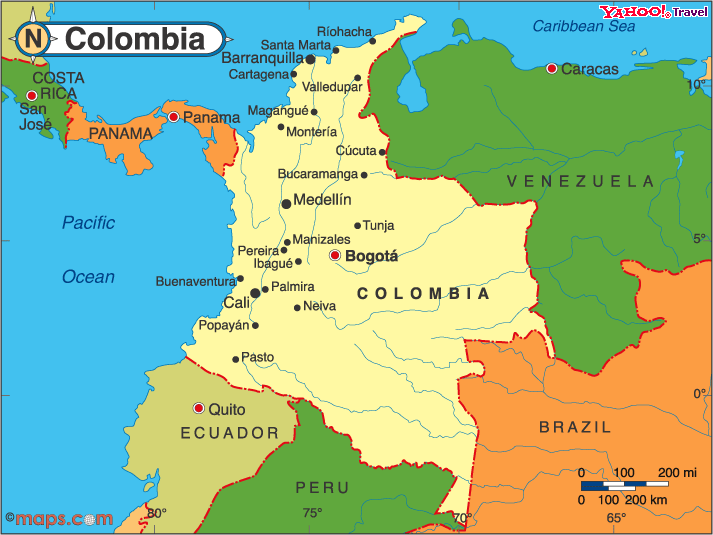
Colombia, the fourth-largest and third-most-populous country in South America, is bordered by Ecuador, Peru, Brazil, Venezuela, and Panama. Its long coastline is split by the Isthmus of Panama between the Pacific Ocean and the Caribbean Sea. The country's coastal plains, where the vast majority of its 44.2 million (2010) people live, give way to rugged mountains and eastern grasslands. Unlike most of the countries we will consider in this course, Colombia has not experienced by an authoritarian regime (for example, a military dictatorship) in recent decades.

Some Colombians you might have heard of:  the pop singer Shakira, the Nobel Prize in Literature winner Gabriel Garcia Marquez (One Hundred Years of Solitude), the Formula One race car driver Juan Pablo Montoyez, and the rock and roll musician Juanes.  Actress Catalina Sandino Moreno was nominated for an Academy Award for her performance in “Maria, Full of Grace,” the story of a young woman who mules drugs from Colombia to New Jersey.  And many know the coffee bean picker Juan Valdez, a fictional character used to promote Colombian coffee. Speaking of coffee, see this very-recent Washington Post piece on this year's World Barista Championship.

Colombia's colonial history illustrates well the patter described in my Week 2 blog: The first Spanish settlements date to 1510, and by midcentury the foundations for colonial society were established. Thought the encomienda and draft labor systems, indigenous people were forced into something close to slavery; as their numbers dwindled due to disease and desertion, many Africans were enslaved and brought to the colony to fulfill its labor requirements. The colonial economy was based on agriculture and gold mining, supplemented in the seventeenth century by trade. In the eighteenth century, the Spanish Crown created the Viceroyalty of New Granada, centered in the present-day capital, Bogotá. Simón Bolívar defeated the Spanish near Bogotá in 1819, establishing and becoming president of Gran Colombia (comprising contemporary Colombia, Venezuela, Panama, and Ecuador). Following the breakup of this entity by 1832, the foundations were laid for the modern Republic of Colombia.

In the early twentieth century, coffee became the engine of the economy, spurring industrialization and urbanization. Freely elected civilian governments represented both the Liberal and Conservative parties. Interparty rivalry led to an extended period of civil war, known as "La Violencia," between 1948 and 1958, costing some 300,000 lives. In 1957 a power-sharing alliance, the National Front, ended the war; the alliance was phased out by 1974.

The Revolutionary Armed Forces of Colombia (FARC) was established in 1964 as an armed Marxist-Leninist revolutionary movement and has since expanded to gain de-facto control of large portions of rural Colombia. Subsequent governments struggled with terrorist violence by the FARC insurgency and other left-wing guerrilla organizations, drug cartels, and paramilitary forces.

During President Alvaro Uribe's two terms (2002-2010), security improved, with significant gains against drug trafficking and increased military pressure against the FARC guerrillas. Juan Manuel Santos, Uribe's defense minister, became president in 2010.

Despite its ongoing internal political strife, Colombia remains a culturally rich and vibrant country, with a dizzying array of urban landscapes and beautiful rural landscapes.  Check out this short promo clip to see some highlights:

II. Understanding the Major Players in Colombia's Political Violence

As we begin getting familiar with the theme "political violence" in Colombia, I would like to suggest that you resist the temptation to determine who are the "good guys" and who are the "bad guys."  What makes Colombia so troubling (and so fascinating) is that, at this point in time, it is very difficult to tell who is on whose side and how armed groups official ideologies (which may sound very good) match up to what they actually do (which may sound very bad). Take this suggestion seriously as you read the selections from Michael Taussig's Lawless Land: Diary of a Limpieza Campaign in Colombia.

Prior to moving forward, make sure you have printed out handouts 2 and 3. Look at them from time to time as we move ahead.

In order to understand political violence in Colombia, you need to get familiar with two groups and a government initiative. The two groups are the FARC and the Paras, and the initiative is Plan Colombia. Be aware that Colombians have very strong feelings about these three issue. (If you have any Colombian friends or teachers, you will find out quickly.) Look over this short article to get your feet wet.

Here are short introductions to each of these:

The Revolutionary Armed Forces of Colombia (FARC) was established in 1964 as an armed Marxist-Leninist revolutionary movement. Since its inception, the FARC has been based geographically in the southeastern jungles and in the plains at the base of the Andes. According to its official ideologies, the FARC claims to represent the rural poor in a struggle against Colombia's wealthier classes. It opposes U.S. influence in Colombia (particularly Plan Colombia), and it fights against the privatization of natural resources, against multinational corporations, and against paramilitary violence. The possible appeal of these priorities and principles has been complicated by the FARC's actions, including armed insurgency (guerilla) campaigns against successive Colombian governments (with the goal of seizing power through an armed revolution) and involvement in Colombia's international drug trade. Within the international community, the FARC is considered a terrorist organization due to its well-documented random kidnappings, violence, and human rights abuses.

Paramilitary Forces are groups
whose function and organization are similar to those of a professional military, but which is not considered part of a state's formal armed forces. In Colombia, in recent years several massive paramilitary forces (or, to use the colloquial term, "Paras") have emerged. In the beginning, these groups claimed to be protecting ordinary citizens from insurgent groups like the FARC, since the state police and military was failing to do so. In time, the interests and priorities of the Paras have become much more complicated. An umbrella group you should know about is the United Self-Defense Forces of Colombia (Autodefensas Unidas de Colombia, or "AUC"), which consolidated multiple paramilitary groups into one umbrella organization and presently has somewhere between 10,000 and 25,000 members. Like the FARC, AUC is considered a terrorist organization by multiple countries and organizations, including the United States and the European Union. Also like the FARC, Colombian paras have been linked to drug production and trafficking. Unlike the FARC, they have collaborated with the Colombian police and military and have received funding and support from the government--funding which, at least in part, came from the U.S. via Plan Colombia (see below). Listen to this NPR story on right-wing paramilitaries and the assassination of union leaders. (This is the topic of Leslie Gill's short readings about Coca Cola in Part 2.) 

Plan Colombia. Conceived and implemented in the late 1990s, Plan Colombia emerged out of a series of conversations between Colombia's late-1990s president, Andrés Pastrana, and the U.S. administration of Bill Clinton. For his part, Pastrana was interested in social and economic revitalization, ending the armed conflict and creating an anti-drug strategy; the priorities of the U.S. were counternarcotics projects (following the "War on Drugs" approach), and sustainable economic development projects that would convince coca farmers to grow and market other crops. Having cost us several billion dollars to date, Plan Colombia is the U.S.’s largest military aid initiative outside of the Middle East.

Watch at least the first half of the following hour-long PBS special on the FARC and the Paras:


III. Michael Taussig
Michael Taussig is a senior anthropologist and longtime professor on the faculty at Columbia University. Over the years, he's written on variety of themes, including peasants, violence, capitalism, religion, healing and medicine. In his text, based on fieldwork carried out in 2001, one gets a good idea of what life is like in the Colombian countryside, where paranoia and fear of both the FARC and the Paras permeates the consciousness of ordinary citizens. The narrative Taussig tells is chilling, but it is real and, for the most part, is still happening. As you read, attempt to answer these questions:
  1. What is a limpieza campaign?
  2. Who carries them out?
  3. Who are the targets?
IV. Some Updates
Between 2003 and 2006, the Colombian government began a campaign to demobilize the United Self-Defense Forces of Colombia (Autodefensas Unidas de Colombia/AUC), an armed coalition of regional paramilitary groups that had been regularly accused of murder, forced displacement, extortion, and other human rights violations against local populations in their efforts to combat left-wing insurgents in Colombia. Although over 30,000 persons involved in the AUC were disarmed during this controversial campaign, there is growing concern that new paramilitary groups have since emerged, and formerly demobilized paramilitaries are reconstituting themselves as criminal gangs.
 

Despite government efforts at eradication of the coca crop, Colombia remains the world's leading producer of coca, and is a major supplier of cocaine to the U.S. and other international markets. It also produces opium poppy (used in heroin production), although cultivation is estimated to have decreased significantly since 2006, and cannabis (marijuana).
 
The FARC insurgency was weakened in September 2010 when Colombian security forces killed the group's second in command. The bombing raid in a remote mountainous area, coupled with a ground operation, also killed about twenty FARC members.
 
In July 2008, under Operation Jaque, Colombian military commandos succeeded in a dramatic rescue of fifteen FARC hostages, including three U.S. military contractors. Among the hostages was Ingrid Betancourt, a French-Colombian politician who had been held for six years.

PART 2. Women’s Lives and the Institutionalization of Feminism
Associated Readings

  1. Jane Jaquette, “Women and Latin American politics,” in Latin America: Its Problems and Its Promise, pp. 190-206 (2011)
  2. Donna Murdock, “Neoliberalism, gender, and development: Institutionalizing 'post-feminism' in Medellín, Colombia,” Women's Studies Quarterly 31(3/4), 129-53 (2003)
  3. Leslie Gill, “Labor and human rights: ‘The real thing’ in Colombia,” Transforming Anthropology 13, pp. 110-115 (2005)
  4. Leslie Gill, “Colombia: What's next?” NACLA Report on the Americas, pp. 30-32 (2009)
Handouts ("Course Documents" on Bb)
  1. Handout 4. Latin American Feminisms

Having accompanied Taussig on his ethnography of political violence in small-town Colombia, we now turn to a different set of issues in a different region:  the struggles of women’s rights groups in beautiful mountainous city of Medellín. Located in the northeastern region of Colombia (look it up on Google Earth), Medellín is situated in the northernmost foothills of the Andes. For much of the 1980s and early 1990s, Medellín had the dubious reputation as a violent center for international drug trafficking. Since the arrest and murder of Medellín’s major drug cartel leaders, however, relative peace and foreign tourism has slowly returned.

In her ethnographic research conducted in the late 1990s, anthropologist Donna Murdock considers what happens to feminist organizing under broader conditions of neoliberalism. As she discusses in her article, one of the major trends women’s groups in Colombia faced in the 1990s was toward growing institutionalization, professionalization, and “NGOization.” To understand what these terms mean, we need to address background on neoliberal policy in Colombia and on Latin American feminisms.

I. Colombia and Neoliberalism
As you know from last week’s blog, Latin American economies were characterized by stagnation and inflation in the 1980s, due in large part to the debt crisis (itself a reflection of the 1973 Oil Crisis). Remember from my Week 2 blog entry that to “rescue” Latin American economies from further implosion (thereby ensuring that debt repayment could resume), international lending institutions like the IMF and World Bank imposed “structural adjustment” policies which enacted austerity measures to slash government budgets, for example, by freezing the wages of government employees and lowering public expenditures for social services such as health and education. Structural adjustment policies also asked Latin American states to increase exports and remove barriers on trade--to reintegrate their national economies, in other words, into the global market. As I have stated earlier, the immediate consequences of structural policies enacted in the 1980s were both positive and negative.  On the one hand, these policies did successfully stabilize many Latin American economies (curtailing skyrocketing inflation rates, for example). On the other hand, the slashing of public social services proved devastating for the quality of life of ordinary citizens. During the 1980s, thus, economies stabilized, but poverty and social inequality deepened.

In Colombia, structural adjustment policies implemented by Colombia’s president Pastrana in the late 1990s cut federal budgets for health care, education and for development programs. While these cuts allowed Colombia to meet its debt repayment obligations to the Work Bank, they triggered a major internal economic and political crisis, exacerbating political violence and the quasi-“civil war” between the FARC, the Paras, and the government police and military.

II. Latin American Feminisms
Note: This paragraph follows Handout 4 (“Latin American Feminisms”)
Neoliberal structural adjustment policies also had major implications for social movements such as the feminist/women’s movement. “Feminism,” as many of you already know, is broadly concerned with improving the status of women. But beyond this very general idea, we need to locate the meaning(s) of feminism in a specific historical/cultural context, since “feminism” has been an evolving and at times contested concept throughout the 20th century. In the United States, the 1960s and 70s were witness to the emergence of “second wave” feminism, focused on social equality for women (not just legal equality, as had been the focus of first-wave feminism). Latin American feminism of the 1970s shared this commitment to social equality for women, but was in many ways more radical than its US counterparts since Latin American feminists wanted more than simply equality within existing social structures. Rather, they advanced a deep critique of these very structures--not just gender structures, but also the oppressive structures of race and class. The tactics of 1970s Latin American feminism were forms of popular education such as “consciousness raising.” Raising consciousness meant helping oneself and helping others to become politically conscious. Consciousness raising groups aimed to get a better understanding of women's oppression by bringing women together to discuss and analyze their lives, without interference from the presence of men. Over the 1980s, Colombian feminists worked tirelessly to develop consciousness-raising groups and other women’s groups. Most of these Colombian feminists were volunteers and most were poor and had little if any formal education. Working with extremely limited resources, these feminists nonetheless provided valuable resources to other poor women.

In Colombia as elsewhere in Latin America, things changed in the 1990s, due to two interlinked processes. First, the so-called “globalization of feminism” brought on by the rise of international women’s summits such as the Beijing Women’s Conference. Against the backdrop of growing transnational networks, “feminism” became appropriated by governments and states. Rather than grassroots-based, it became incorporated into state “development projects.” 


To understand this shift, you might think of two models: One is a group of poor women who without funding find neighborhood spaces to provide shelter, consciousness-raising, and other forms of popular education to other poor women. The other is a policy-oriented woman’s rights non-governmental organization (NGO), funded through government and international development grants and staffed by professionalized women with relatively high levels of formal education.

With the globalization of feminism, the activities of the women’s movement in Colombia as elsewhere in Latin America shifted from the former model to the latter--and the tension between these two models is the context for Donna Murdock's study.

As the women’s movement became increasingly professionalized and “NGOized,” the radical feminism of earlier years met a growingly hostile reception. With few exceptions, today’s feminist NGOs in Latin America are staffed by well-educated women.

Concurrent to the institutionalization of feminism in the 1990s, let’s not forget that this was also a time when Latin American governments were being “downsized” due to fiscal austerity measures designed to reduce government spending. With diminished resources, the state increasingly turned to feminist NGOs to provide services and expert knowledge to poor women. (This has been called the “privatization of the state.”) Instead of consciousness-raising, feminist NGOs have increasingly focused on short-term projects, workshops, forums, and participation in the policy arena. An influential discourse about improving the status of women through these approaches (rather than the radical politics of earlier feminism) has emerged.  It is called the "Gender and Development" framework.  See this link from the World Bank's "Gender and Development" website to better understand this discourse.

This pattern--NGOs taking on the activities formerly the responsibility of the state--took off in the 1990s and arguably has yet to subside. (My own recent work focuses on the rise of the “NGO sector” in the Brazilian city of Porto Alegre.)